
Demographic analysis
A total of 1294 questionnaires were distributed across participating sites. Of these, 1135 valid responses were received, yielding an effective response rate of 87.7%.Among the respondents, the majority were female (81.32%, n = 923), while male participants accounted for 18.68% (n = 212). The age distribution was as follows: 26–35 years (38.85%) comprised the largest group, followed by 36–45 years (27.84%), 18–25 years (22.82%), and 46–55 years (10.22%). Only a small proportion (0.26%) were older than 56 years.In terms of educational background, 45.46% of participants held a bachelor’s degree, 22.03% had education below the bachelor’s level, 20.7% held a master’s degree, 11.54% had completed a doctoral degree, and 0.26% were postdoctoral researchers. Respondents represented a range of clinical departments. Internal medicine was the most common (28.55%), followed by surgery (22.29%), otolaryngology (12.95%), ophthalmology (12.86%), obstetrics and gynecology (7.31%), intensive care (7.75%), emergency medicine (4.41%), dentistry (2.73%), and dermatology (1.15%). Regarding clinical experience, 34.45% had 16–25 years of working experience, 31.81% had more than 25 years, 17.0% had less than 5 years, and 16.65% reported 5–15 years of experience. These demographic characteristics are summarized in Table 1.
Measurement model (CFA) and inter-item associations
A confirmatory factor analysis supported the a priori eight-construct measurement model for the 5-point ordinal items (WLSMV with polychoric correlations; N = 1135). Global fit was excellent (χ2(254) = 915.344, CFI = 1.000, TLI = 0.999, RMSEA = 0.048, SRMR = 0.022). Standardized loadings were uniformly high (all λ ≥ 0.84); item-level loadings and SMC are reported in Supplementary File 2. The inter-item correlation matrix in Supplementary File 3 (computed using Spearman rank correlations) showed strong within-construct cohesion and theory-consistent moderate correlations between related constructs (e.g., CG–KS, SET–TPB, RAT–SS), with no extreme pairwise correlations indicating redundancy. CR and AVE met recommended thresholds for all constructs (Supplementary File 2, Table S3), and discriminant validity was acceptable overall by the Fornell–Larcker criterion and HTMT (Supplementary File 2, Tables S4–S5).
Feature selection and interpretation
Feature selection and behavioral interpretation using LASSO
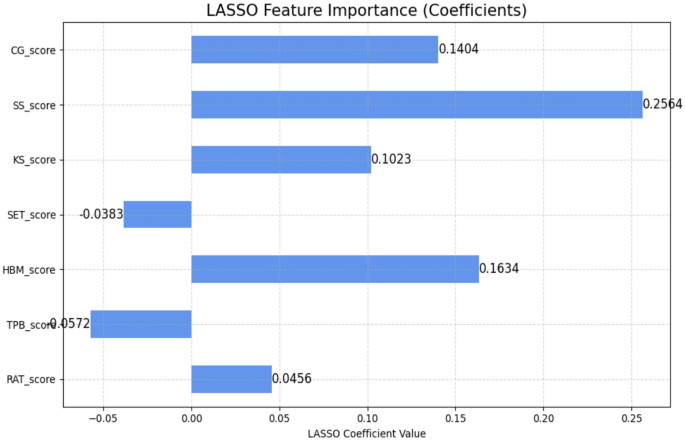
LASSO regression with five-fold cross-validation was used to identify key psychological predictors of healthcare workers’ intention to use antimicrobials appropriately (i.e., guideline-concordant use). All seven constructs were retained, though their contributions varied in both strength and direction (Fig. 1). Social support (β = 0.2564) was the strongest predictor, underscoring the role of institutional culture and peer reinforcement in shaping prescribing behavior. Healthcare workers embedded in supportive, stewardship-oriented environments may be more inclined to adhere to appropriate, guideline-concordant antibiotic use. This aligns with organizational psychology literature, which emphasizes the behavioral impact of social norms and workplace context. The Health Belief Model (β = 0.1634) was also a significant predictor. Perceived susceptibility, severity, and benefits appear to meaningfully influence prescribing intent—particularly in settings where risk perception and clinical outcomes are closely linked. Cognitive processing (β = 0.1404) and knowledge and skills (β = 0.1023) contributed positively, reflecting the importance of analytical reasoning and clinical competence. These findings support previous work linking reflective decision-making and content knowledge with more appropriate antibiotic use.

Lasso feature importance (coefficients).
In contrast, self-efficacy (β = − 0.0383) and the TPB perceived-behavioral-control domain (β = − 0.0572) showed weak negative associations. Although these domains are traditionally linked to intention, their reduced influence here likely reflects the dominant role of institutional policies and norms that constrain individual agency in tightly regulated clinical environments. Theory of Reasoned Action (TRA; operationalized as RAT) showed a modest positive coefficient (β = 0.0456), suggesting that deliberate cost–benefit reasoning contributes but is secondary when structural or perceptual factors are more salient. In the presence of contextual (SS), normative (RAT/TRA), and cognitive (CG/HBM) factors, perceived behavioral control/self-efficacy added limited incremental information, consistent with a protocol-constrained environment where normative and contextual pressures dominate.
Psychological feature contributions and interactions in SHAP analysis
To further interpret the predictive model, SHapley Additive exPlanations (SHAP) analysis was applied to the top-performing XGBoost classifier. SHAP quantifies the individual contribution of each psychological construct to model predictions, enhancing transparency and interpretability. The SHAP summary plot (Fig. 2a) illustrates the magnitude, direction, and distribution of each feature’s influence. Cognitive processing (CG_score), social support (SS_score), knowledge and skills (KS_score), and health belief model (HBM_score) constructs showed the highest contributions. Among these, cognitive processing had the strongest positive effect—particularly at higher values—indicating greater intention to use antimicrobials appropriately. In contrast, TPB, RAT, and SET constructs were excluded from visualization due to minimal importance, reflecting their limited influence in the final model. The mean absolute SHAP values (Fig. 2b) confirmed this ranking, with cognitive processing emerging as the most influential factor, followed closely by social support and knowledge and skills. This pattern highlights a hierarchy of predictors in which cognitive and contextual variables outweigh traditional volitional models in this behavioral context.

SHAP-based feature importance and nonlinear relationships in predicting intention to use antimicrobials appropriately.
SHAP dependence plots revealed non-linear relationships and potential interactions. In Fig. 2c, social support displayed a positive but nonlinear association with intention to use antimicrobials appropriately, with stronger effects at higher scores. Color gradients indicating cognitive processing scores suggest an interaction, whereby the effect of social support may be modulated by analytical engagement. Similarly, Fig. 2d shows that the influence of knowledge and skills may also be shaped by social context. Figure 2e and f explore HBM and cognitive processing effects respectively, both demonstrating threshold-based increases in predicted intention at moderate to high levels.
Bootstrapped logistic regression analysis of psychological predictors
Figure 3 presents the results of bootstrapped logistic regression, displaying the median coefficients and 95% confidence intervals (CIs) for seven psychological constructs in relation to healthcare workers’ intention to use antimicrobials appropriately. Four constructs showed statistically significant positive associations, with CIs that did not cross zero. Social support (SS_score) emerged as the strongest predictor (Median = 1.72), underscoring the influence of institutional context and peer reinforcement in promoting stewardship-aligned behavior. Cognitive processing (CG_score, Median = 1.42) and knowledge and skills (KS_score, Median = 1.40) followed closely, highlighting the importance of analytical engagement and clinical competence in prescribing decisions. The health belief model (HBM_score, Median = 1.03) also showed a significant positive association, indicating that perceptions of risk and severity surrounding antimicrobial resistance shape prescribing intent. In contrast, constructs derived from the Theory of Planned Behavior (TPB_score, Median = − 0.20) and Self-Efficacy Theory (SET_score, Median = − 0.15) had confidence intervals that included zero, suggesting limited and statistically uncertain effects. RAT (Theory of Reasoned Action, TRA) showed a weak positive coefficient (RAT_score, Median = 0.20) with a wide CI overlapping zero, indicating low robustness.

Bootstrapped logistic regression of psychological predictors of intention to use antimicrobials appropriately.
Comparative performance of machine learning models by intention level
Figure 4 presents a comparative evaluation of eleven machine learning models in classifying healthcare workers’ behavioral intention (BI) to use antimicrobials appropriately, categorized as High, Medium, and Low. Model performance was assessed using precision (Fig. 4a), recall (Fig. 4b), and F1-score (Fig. 4c). Ensemble models, including Voting, Stacking, and XGBoost, demonstrated consistently high performance in predicting High and Medium intention groups, with F1-scores exceeding 0.94. The Voting classifier achieved the highest overall balance, with F1-scores of 0.96 and 0.95 for High and Medium groups, respectively. Logistic Regression and Support Vector Machine (SVM) also performed well for High and Medium categories, although performance declined in classifying the Low BI subgroup. For example, SVM reached an F1-score of 0.97 for High intention but dropped to 0.76 for Low intention, suggesting reduced sensitivity to less distinct behavioral profiles. AdaBoost and Gradient Boosting showed similar performance patterns, with lower F1-scores for the Low category (0.76 and 0.79, respectively). Across all models, classification of the Low intention group proved more challenging. Even top-performing algorithms struggled to balance precision and recall. For instance, Naive Bayes achieved a high recall (0.92) but low precision (0.69) for the Low group, resulting in a moderate F1-score of 0.79—indicating a tendency to over-predict without sufficient specificity. Similarly, LightGBM and Multilayer Perceptron (MLP), despite solid overall performance, recorded F1-scores near 0.80 for the Low group, reflecting consistent difficulty in accurately identifying individuals with weaker behavioral intentions.

Comparative performance of machine-learning models by intention level for appropriate antimicrobial use.
Discriminative performance of models based on multi-class ROC curves
Figure 5 illustrates the multi-class Receiver Operating Characteristic (ROC) curves for eleven machine learning models across three levels of behavioral intention—High, Medium, and Low—to use antimicrobials appropriately. The Area Under the Curve (AUC) values are reported for each class, providing a quantitative assessment of each model’s ability to discriminate between intention categories.

Multi-class ROC curves for classifying intention to use antimicrobials appropriately (high/medium/low).
Ensemble models—particularly Voting, Stacking, and XGBoost—demonstrated consistently strong discriminative performance, each achieving AUC values of 0.99 across all three intention levels. These results highlight their robustness in capturing complex decision boundaries and maintaining balanced accuracy across class distributions. LightGBM also performed exceptionally well, with AUCs of 0.98 for the High and Medium groups, and a perfect 1.00 for the Low intention category—traditionally the most challenging to classify due to class imbalance. This suggests LightGBM’s capacity to detect nuanced distinctions in underrepresented subpopulations. AdaBoost and Gradient Boosting followed closely, with AUC values ≥ 0.98 across all categories, further validating their effectiveness as competitive ensemble classifiers. Among traditional algorithms, Logistic Regression, SVM, and MLP also exhibited high AUC values (≥ 0.98), though with slightly more variation across intention levels. For example, K-Nearest Neighbors (KNN) recorded a lower AUC of 0.95 for the Low group, indicating potential limitations in handling imbalanced data or diffuse class boundaries. Naive Bayes, despite its relatively lower F1-scores in earlier analyses, achieved surprisingly strong AUCs—0.97 for High and Medium, and 0.96 for Low—suggesting that it effectively distinguishes between intention levels on a probabilistic level, though its calibration and precision-recall trade-offs may require further refinement.
link